
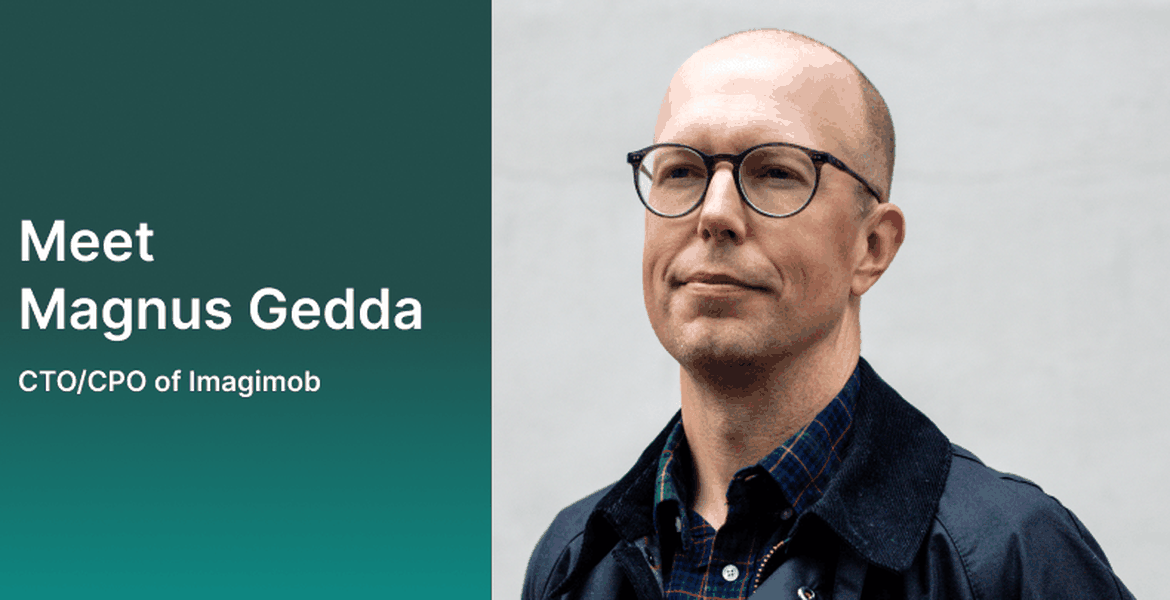
Meet our CTO Magnus Gedda!
We recently sat down with Imagimob’s new CTO/CPO Magnus Gedda, to discuss what drew him to the company, the opportunities ahead for Edge AI, and his vision for the future of DEEPCRAFT™ Studio. Bringing together deep technical expertise and a strong product leadership background, Magnus shared his perspective on scaling innovation, building products that empower users, and navigating the fast-evolving landscape of AI at the edge. With his goals tofoster a culture of quality, experimentation, and ownership, there is plenty to look forward to.
Welcome aboard! What drew you to Imagimob and this CTO role?
Thank you! I have always been interested in deep-tech startups and cross-functional roles. And before I came to Imagimob I had already spent five years in the Edge AI field — which is a very exciting field — so Imagimob was well known to me. Edge AI is getting adopted at a fairly steady pace today, but it is still somewhat of an emerging technology with lots of opportunity and interesting challenges which I find very exciting.
The role was originally presented to me as a CPO role, but with "CTO flavor", so basically a combined CPO/CTO role. The previous organizations I've been in — mostly small startups and scaleups — have been very technology-focused and lacked a lot of the product perspective, so I often became sort of a product champion trying to drive the product work on top of my engineering responsibilities. Over the years this eventually got me into a position of product leadership, and having deep technical expertise and product experience I would say is a good combination and a career path that I am passionate about. So now when the opportunity presented itself to move into an executive position combining the two responsibilities in the field of Edge AI it felt like a perfect fit for me.
I find the role very interesting in itself, but I am also drawn to the hybrid situation that comes with being a startup that was recently acquired by a large organization. Since it is still being run as a separate entity it gives us the flexibility (and challenges) of a startup but with the strength and backing of a big multinational company. I am looking forward to being a sort of bridge between the two and aligning our work on a both technical and strategic level, and ensuring that we at Imagimob utilize our competencies in the best possible way to provide Infineon and their customers with great tooling and solutions for Edge AI.
What excites you most about this role—and why now?
There are a number of things that make this role very exciting. We are still very small and because of this we have been able to move fast and build a very impressive platform. If you look at the scale of the platform and the size of our team you could say that we have pulled well above our weight. But then we need more processes and structure as we expand and grow. One of the most challenging aspects of this role will be shaping the engineering/product organization and finding sensible processes that enable us to grow and deliver high quality products without limiting the flexibility or throughput.
Also, being part of Infineon's strategic focus on Edge AI is very exciting. It is a growing field and this has become a differentiating factor for microcontroller manufacturers. Getting the opportunity to be part of strategic discussions on how to best enable Edge AI on Infineon's MCUs, both on current and future hardware, while at the same time being involved in the technical execution to make this happen is a rare privilege. In a big organization you are usually either involved in strategy or part of the execution, seldom both.
Another exciting thing is how fast the field of AI/ML is evolving. The field is changing rapidly and new technology is popping up at a high rate. Keeping track of industry trends has become vital. Aligning with the trends and adopting the emerging technologies on constrained hardware, and coordinating the efforts with a big hardware company with more traditional and longer processes is challenging.
From your perspective, what makes Edge AI such a compelling space right now?
Edge AI has always been compelling as a vision, but now the technology is catching up and making that vision a reality. MCUs are getting more powerful and machine learning models are getting more sophisticated. We have had traditional machine learning algorithms for a long time but the developments we've seen in neural-network-based models and boost of supporting toolchains for a while now have really accelerated the accessibility of Edge AI.
Where do you see the biggest technical opportunities—or challenges—for Edge AI in the coming years?
The biggest opportunities right now are obviously in adapting the agentic workflows. That will be a challenge because the tooling will need to be reshaped in order to best facilitate the agentic development. Coding agents have become a fundamental part of software development, but Edge AI development is different and more complex. Leveraging agentic development will help with both speeding up the development and adoption, and also finding new and interesting use cases and solutions.
The biggest challenge that I see is scaling deployment. The technology is so complex and requires a lot of hands-on operation, and driving this to scale is going to continue to be a big challenge. Another challenge will be providing high-level standardized interfaces for the hardware to spread adoption while at the same time cater to the need for custom hardware that utilizes acceleration.
How do you approach building great products in a space that balances cutting-edge AI with real-world constraints at the edge?
In such a complex area as Edge AI, where hardware constraints interplay so much with the software development, you have to be really mindful about the details. But as for all great products, the most important part is the user. The users will play a vital part in driving the Edge AI area forward. But one problem with being at the cutting edge of Edge AI is that it's a relatively new field and the majority of the industrial customers have very little experience. This means that we have to help educate them, open up their minds to what is possible, and also help drive a lot of the innovation and solutions.
What kind of engineering culture do you believe is needed to drive innovation and deliver high-quality products?
I believe in the fundamental principles, like keeping the teams small and effective to align the workflows. Focus a lot on quality in all parts of development and delivery. Encourage interaction between teams and have an organization with processes and workflows that allow us to scale. I also want to encourage discovery and innovation, and to promote thorough product work with proper planning and user testing included in the agile development process. All this is a bit of a challenge in a small startup organization, but getting a good engineering culture in place in the early stages will help us as we grow.
How do you empower teams to experiment and move fast, while staying aligned with long-term goals?
We are a very small team which makes communication easy and we have short feedback loops. This enables us to have everyone stay aligned long-term but also allow for experimentation. The members of the team are very talented and have a lot of agency so whenever interesting innovative ideas pop up we encourage some experimentation. Communication is key here with short feedback loops.
Looking ahead, what are you most excited to build or achieve with the team?
I am most excited about building great tooling that facilitates the customers to deploy Edge AI on the Infineon hardware line. To see Edge AI being adopted at a larger scale, and solutions being deployed through our tooling is what drives me. We really want to provide a great way for Infineon customers to solve problems with Edge AI.
We are happy to have you on board and look forward to advancing DEEPCRAFT™ Studio, driving Edge AI adoption, and helping customers unlock new possibilities with AI at the edge.